

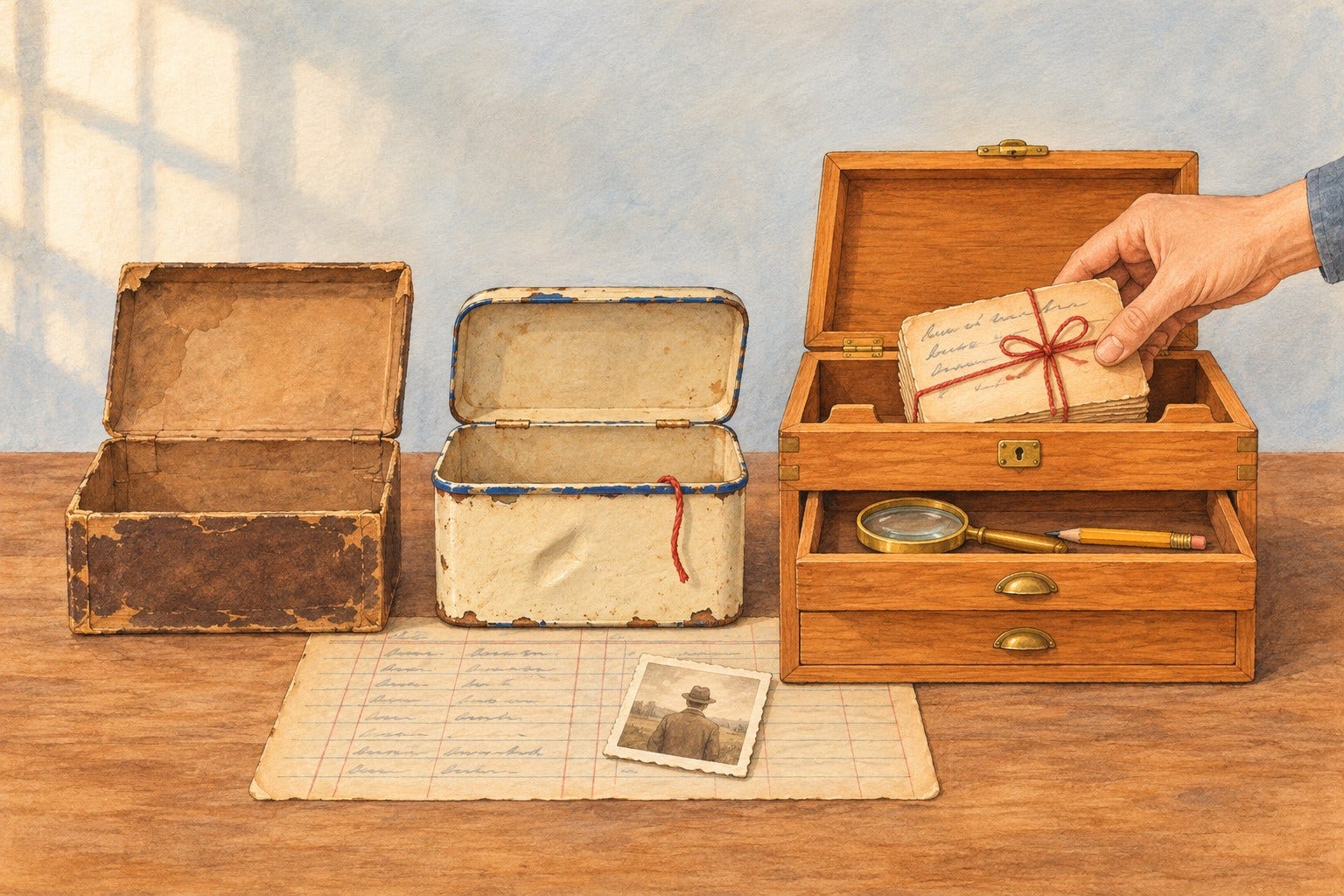
Today I’m opening the doors to AI Genealogy Tools, a free, searchable directory of the AI tools I’ve built for family historians.
https://aigenealogytools.vibegenealogy.ai/
It’s a public beta. I’m still checking pages and adding the dates when each tool was first shared, so you may find a rough edge or two. If something doesn’t work, every tool page has a Report a problem with this page link, and I’d be grateful if you used it.
When OpenAI announced that it would retire Custom GPTs, some of you asked how you could keep using mine after December 11. This directory is my answer. I expected the Genealogical Research Assistant to come up. What surprised me was hearing about tools I hardly open anymore. Somewhere along the way, an experiment I had finished with had become part of somebody else’s way of doing genealogy.
The directory has 63 entries. Thirty-four of them are tools I’ve moved over from Custom GPTs. The rest are newer tools and research resources. If you remember the name of a tool, type it in the search box. If all you remember is what it helped you do, describe the job. Try old handwriting and you’ll land on Steve’s OCR/HTR Transcription Tool. Every page has a worked example you can read before you decide whether to open the tool.
One reason to bookmark the directory now is that OpenAI has set December 11, 2026 as the retirement date for most Custom GPTs. Until then you can follow the original ChatGPT link on each page. You can also download the skill today and keep a copy. That same page is where I’ll share a public plugin link once I’ve verified that it works for you and not just for me. Each page explains which edition you can use and what we saw when we tested it. OpenAI’s retirement notice gives the timetable and the exceptions for workspaces.
A few things you’ll find in the tool chest
The Genealogical Research Assistant is the one you asked about most, and it’s probably the best record of my own education in all this. I began it in spring 2023 and was still revising it for the July 2026 release of version 9.2. One question I bring to it comes from my own tree. In 1850, Harrison Goodman lived in John Goodman’s household. What could I write about his parentage on the strength of that entry? The enumerator put them under one roof. That census didn’t ask how they were related. Getting an assistant to respect the distance between those two facts has been worth years of tinkering.
Then there’s Lingua Maven, one of my first GPTs and still a favorite. It’s a slightly spicy dictionary, thesaurus, usage guide, and language editor, and I still reach for it several times a week. I might go in looking for a synonym and come out having decided that my original word was fine and the sentence around it needed help.
Some of you asked for the Facts Extractor and the Fact Narrator, and both are there under the names you know. One of you asked for the old GRIP Group Photo Analyst. Search for that name and you’ll land on Deep Look, which has taken over its job.
Here’s a photograph. Before you read on, take a look. What’s the first detail you notice?
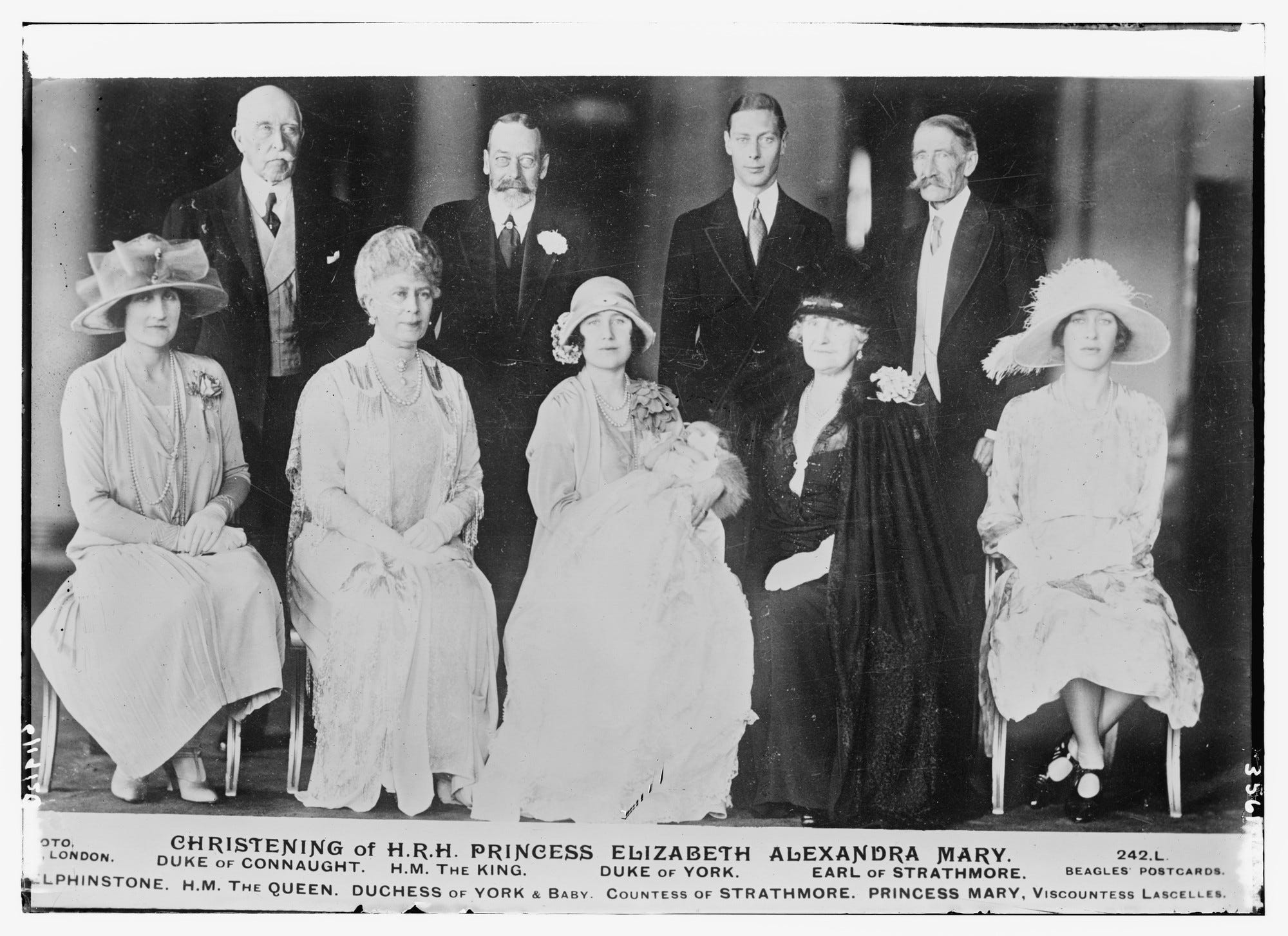

I included Genealogy Eyes because I was surprised to learn how many of you still use it regularly. That sent me back to it with this photograph. I asked what the printed caption could tell us that the faces and clothing never could. It read the baby’s name from the caption. Then it pointed out something that’s easy to overlook once you recognize the family. The caption gives neither a date nor a place. It suggested looking for a contemporary christening announcement. I’d be happy to get that suggestion with an album full of my relatives.
There’s room here for new tools, too
Last week we unveiled the Kinfolk Observatory. Almost immediately it raised a question that any family historian who publishes will recognize. Who helped make this work possible, and have I given them proper credit? Out of that came Credit Finder, my attribution-hunting skill. Give it a project, its credits, and the notes you kept as you worked. It helps you sort out whose contribution you can document and whose influence you still need to check. It’s already in the directory, alongside the older tools.
Very few things in this chest are what I’d call state of the art today. Most of them I seldom use myself anymore. I’m keeping them because some of you do use them, and because together they tell a story I’d like to remember. A genealogist who teaches a computer to read a record in 2023 leaves a rather good record of what it was like to work with a computer in 2023. I’ll keep adding newer experiments so we can see what changes.
So what is all this stuff? Suppose you give an AI a census page. Before it starts, you tell it to copy the surname as the enumerator wrote it, put a question mark beside any doubtful letter, and give the line number so you can check its work. The next time you have a census page, you’ll probably want those same three things. Save those sentences and you have a saved prompt. That’s the family resemblance among most of the tools in this collection. A Custom GPT, a skill, and a plugin are all saved prompts. What changed over the years was where I could put the instructions and how you could get at them.
How a saved prompt became a GPT, a skill, and a plugin
In the summer of 2023, you might have encountered the word plugin for the first time in ChatGPT. OpenAI had introduced its original plugins in March. They let ChatGPT call on an outside service, for instance to look up something current or run a calculation. By that summer I was already working on instructions for genealogical research. An ordinary text file was enough to save them. The awkward bit was getting those instructions into somebody else’s chat.
That got much easier on November 6, 2023, when Custom GPTs arrived. I could give a set of instructions a name, add reference files, and send you a link. You could open our census reader and start with your census page. I’d already done the explaining. The GPT Store opened on January 10, 2024, and OpenAI wound down its original plugin system that spring.
Then came AI assistants that could work their way through files and carry out several steps on your behalf. You’ll hear these called agents. On October 16, 2025, Anthropic introduced Agent Skills. Think of a skill as a folder you can hand to an assistant that knows how to use it. Our census instructions go in that folder. So might a sample transcription or a little program for formatting the results. You can keep a copy, look inside, and see exactly what the author asked the assistant to do.
Now Custom GPTs are being retired, just as those first plugins were, and OpenAI is using the word plugin again. Today’s plugin is a package you can use in ChatGPT or Codex. It can contain a skill, its reference materials, and connections to other tools. In fact, when I migrate a Custom GPT, OpenAI puts its instructions inside the new plugin as a skill. A migrated plugin starts out private, and I have to submit it before it can be listed for everyone. I’m working through that now, starting with the Genealogical Research Assistant, and each tool’s page will say when its public plugin is ready. Until then, the downloadable skill gives me another way to share it with you.
The container keeps changing. The saved prompt moves to the next one. That’s why I’ve come to think of this directory as an archive as much as a tool chest.
This November, four years into ChatGPT
On November 19, Anthropic, the company that makes Claude, went public. On November 30, it will be four years since OpenAI introduced ChatGPT. Four years is barely a footnote in most family histories. It’s long enough, apparently, for a genealogist to find himself running a software archive.
On the morning of the IPO, I wrote about a summer of mathematicians wrestling with how much of their own work AI can now do. Software developers went through that disruption a year earlier. Next, I suspected, would be the physicists, chemists, and biologists. Then the engineers, accountants, doctors, and drug makers. Then the social scientists, lawyers, and consultants.
Last of all, and perhaps never, though I wouldn’t bet on it, come the fields where the work is hardest to check. I named historians, poets, pastors, and preschool teachers. Family historians belong somewhere in that company. I can check whether a computer copied a date correctly. It’s much harder to check a conclusion. A reader picked these three sentences from that post as a favorite passage.
“I expect that knowledge workers who lean into this change will surf through one of the most exciting transitions in human history. The real challenge will be to minimize the number of drownings, because whether you chose to lean-in or not, we’re all going to experience the AI revolution, one way or another. My prayer is that we maximize benefits while minimizing the real harms.”
I went on to say that we don’t know whether passing through this crucible will take two years or twenty. It certainly won’t take the two hundred we needed to adjust to the printing press.
For a family historian, some of that comes down to what happens at the kitchen table. If an assistant helps me read a faded surname, I’ve gained something. If it confidently turns two people in the same household into father and son, that mistake can travel a long way through other people’s trees. I want to keep the instructions that remind us to go back to the record. You can open the archive and see how those instructions have changed.
If there’s a tool you came here hoping I’d saved, start with its old name. If this is your first visit, bring one piece of work from your own research and see what’s in the drawer. Open the AI Genealogy Tools directory.