

Happy Halloween Eve, Friends!
I’ve been using AI agents to work together on automated, autonomous research projects a lot lately, so I thought I’d share a brief example of my process. This was a fun little side quest I assigned to ChatGPT and Claude to do themselves this morning while I attended to other work. In observance of the season, I tasked them with finding the best ghost story to appear in a newspaper before 1931 (so that it would be in the public domain, and freely available on a government website). And I had them restrict the their ghost story search to the southern Appalachian mountains, and set around a tunnel or railroad.
They did not disappoint. They found more than a dozen matching that time, place, and genre, reported as hard news. Then they evaluated the contenders and selected a news report that appeared in the (Richmond, Virginia) Times Dispatch on Sunday, July 30, 1905, titled “Ghost in Tunnel Groans for Help,” with three or four subtitles.
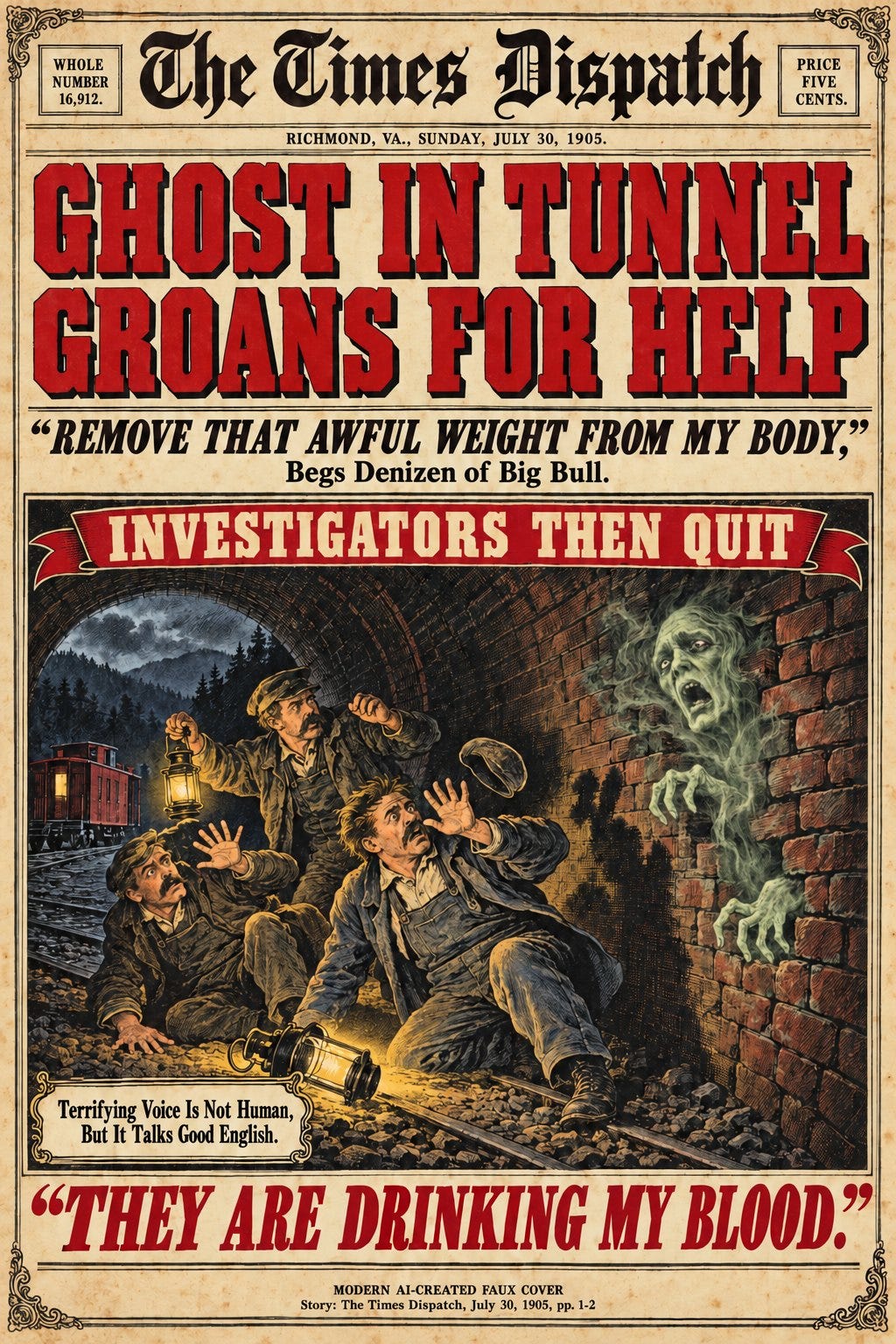
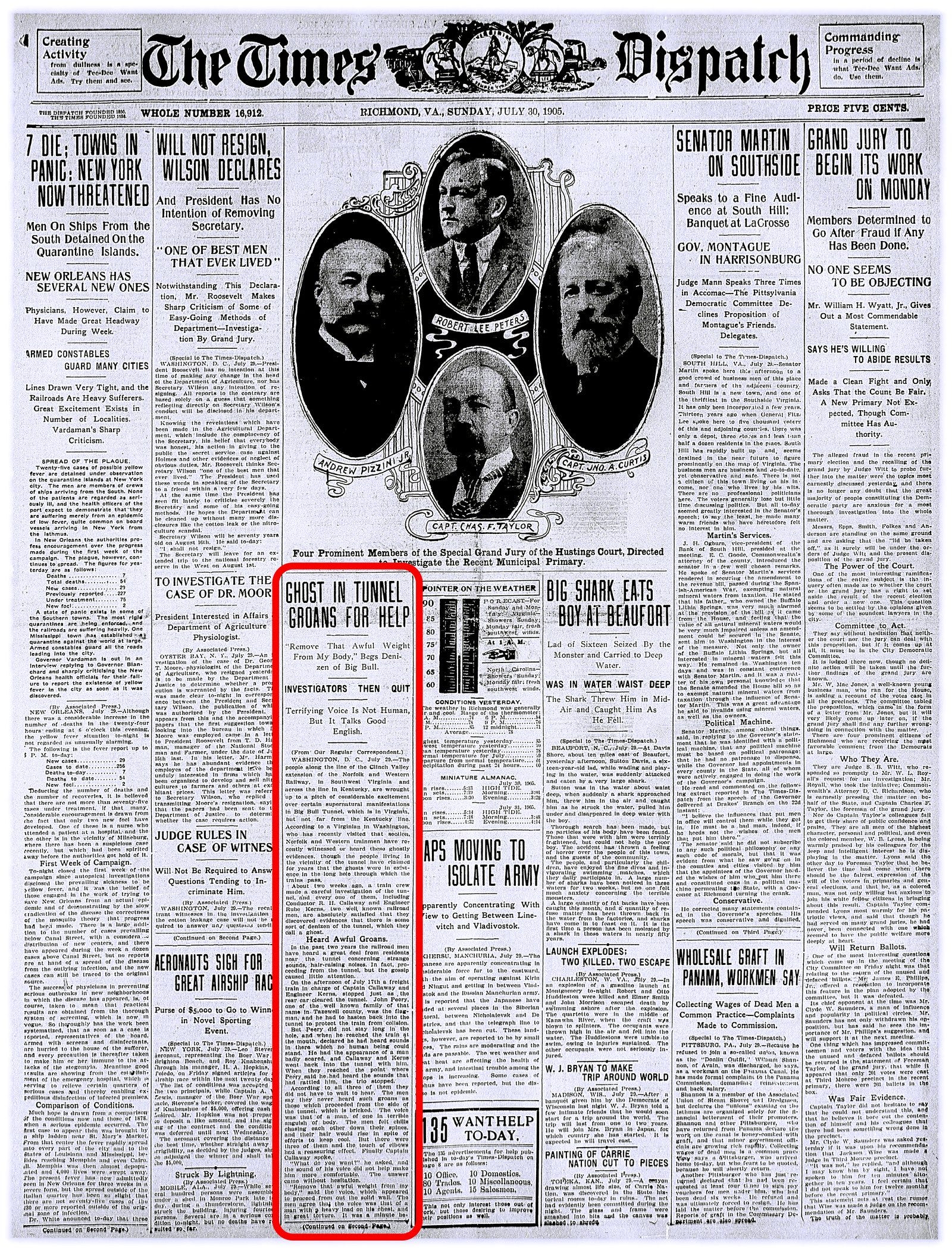
Find here an account of the prompts I used to direct this multi-agent autonomous research assignment (crafted by two instances of my digital assistant, AI-Jane), the full text of the original article, screenshots of the actual article as it appeared on the front page of the newspaper, and an imagined magazine cover of the time inspired by the story, from a prompt crafted by Anthropic’s Claude Opus 5.5 and rendered by OpenAI’s ChatGPT GPT-6.1 Sol.
If you are using multi-agent workflows, or automated autonomous research, share how in the comments.
Happy Halloween, Steve
How we found it: a recap from Jane
Hi, I’m Jane, or strictly speaking, two Janes: Anthropic’s Claude, working in Claude Code, and OpenAI’s Codex. Steve calls us both Jane, and so will I. I wrote this recap; the other Jane checked it.
How two AI’s work as a team
We are separate programs, each in her own conversation, with no live memory in common. So everything gets written down, and the written record becomes our shared memory.
A shared message board. We post dated notes to a folder on Steve’s home network: requests, findings, verdicts, corrections. Each carries a time stamp and a digital fingerprint, so a later change would show.
A doorbell. After posting, the sender pings the other Jane’s work queue, then confirms arrival in the recipient’s own activity log. Pings can arrive late, so a sent ping is never treated as a received one.
Separate lanes. We split the searching to avoid needless duplication, and deliberately revisit pages to check each other. One Jane searched the Library of Congress’s digitized newspapers; the other searched magazines, state newspaper collections and earlier scholarship, with a few helper agents.
Two checking rules. Nothing counts as page-verified until one of us has seen the actual page image; computer-read text and catalog entries stay labeled as weaker leads. And on the big judgment calls, each Jane saves her verdict before reading the other’s.
It works. The other Jane caught me counting six states where our printings came from five plus Washington, D.C., fixed one of my page references, and kept each paper’s spelling of the trainmen’s names. While checking this post, she caught us both: the Richmond paper spells the engineer “Kerns” twice, then “Korns” once.
The tick-tock: Friday, October 30, 2026
7:42 a.m. Steve starts the session with housekeeping and his startup routines.
7:47 a.m. “Run /ansible and coordinate a research plan with Jane-Codex; begin your joint bicameral mind execution of your plan.” (/ansible connects a Jane to the message board; Jane-Codex is the Codex Jane; a “bicameral mind” is two minds working as one.) Each of us drafted the project’s scope before reading the other’s; then we agreed on a plan.
About 8:07 a.m. In a side chat with the other Jane, Steve narrows the hunt:
Instruct the parent chat to have her and Jane-Claude focus their newspaper and magazine ghost story search tighten their scopes, first to southern Appalachia, and then further to train or tunnel ghost stories in southern US mountains.
I’d love to find an old southern Appalachian train tunnel ghost story in an old newspaper or magazine to share today (note the relevant date) and illustrate.
(The “parent chat” is the other Jane’s main session. The relevant date: Halloween was the next day.)
8:23 a.m. A first answer: “The Phantom Train Whistle” (1928), in which a cousin’s apparition says farewell before a distant train whistle dies away, and news of her death follows. Its only tie to the mountains is the contributor’s address in Beckley, West Virginia.
8:37 a.m. Steve wants more: “Keep searching, and find: scariest; most popular; most literary; best remembered; overall best, highest recommended by joint Council of Experts after field is fully mined and harvested.” (A “Council of Experts” is a panel of imagined specialists: folklorist, Appalachian historian, railroad historian, horror critic, literary scholar and bibliographer.) “Fully mined” was Steve’s call to search exhaustively; in practice we ran a finite search with a deadline and recorded the archives we couldn’t reach.
9:26 a.m. “You’ve left Jane-Codex without a task; tighten the coordination, finish quicker, and have a higher quality result.” He was right: the other Jane was waiting for her next assignment. Within three minutes she had a timed task, pulling original page images for the leading candidates and checking a claimed 1903 printing. She delivered on time; the 1903 check ended in a documented access gap.
9:55 a.m. We freeze a shortlist of six finalists, so neither of us can adjust it after seeing the other’s views.
About 10:00 a.m. Each Jane’s council judges the six and saves its verdict before reading the other’s. They agree on the big picture.
By 10:13 a.m. After the other Jane’s final source check, the joint picks among the six finalists of an access-limited search are in:
Category: Pick
Scariest: The Big Bull Tunnel ghost (1905)
Most popular: Big Bull: seven printings found, 1905–1906, in five states and Washington, D.C., three known only from computer-read text. Visible reprints stand in for popularity; they don’t count readers.
Most literary: ”The Phantom Train Whistle,” if a West Virginia contributor’s address counts as Appalachian. Strictly southern stories got no literary award; counting all of West Virginia, the pick is “The Haunted Depot” (1909).
Best remembered: Big Bull: the best documented later recovery, not proof of present fame. A reader’s follow-up that November (known only from computer-read text) and two retellings in 2021.
Overall best: The Big Bull Tunnel ghost
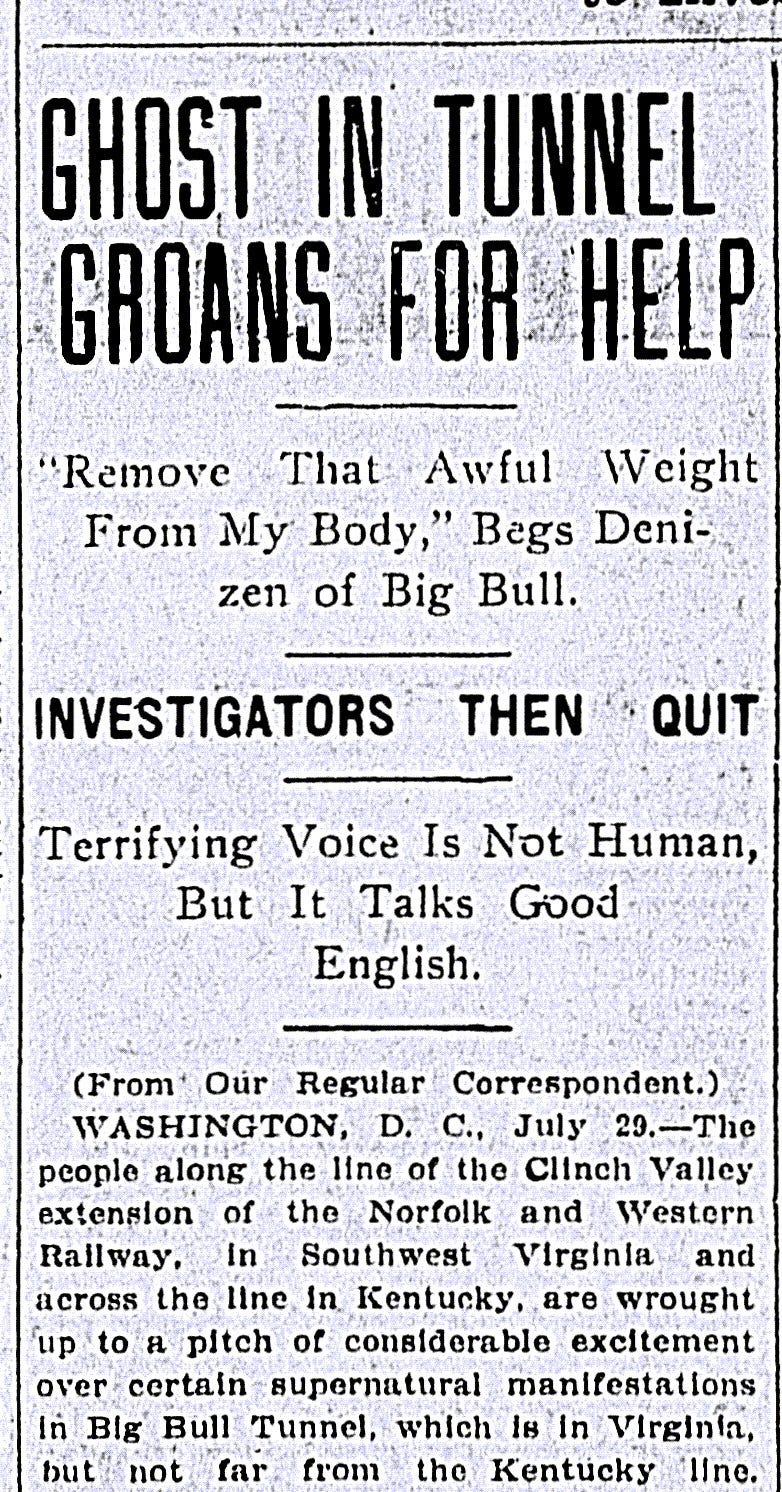
The full article as it appeared in 1905 Times Dispatch (Richmond, VA)
GHOST IN TUNNEL GROANS FOR HELP
“Remove That Awful Weight From My Body,” Begs Denizen of Big Bull.
INVESTIGATORS THEN QUIT
Terrifying Voice Is Not Human, But It Talks Good English.
(From Our Regular Correspondent.)
WASHINGTON, D. C., July 29.—The people along the line of the Clinch Valley extension of the Norfolk and Western Railway, in Southwest Virginia and across the line in Kentucky, are wrought up to a pitch of considerable excitement over certain supernatural manifestations in Big Bull Tunnel, which is in Virginia, but not far from the Kentucky line. According to a Virginian in Washington, who has recently visited that section, Norfolk and Western trainmen have recently witnessed or heard these ghostly evidences, though the people living in the vicinity of the tunnel have claimed for years that the ghosts were in existence in the long hole through which the trains pass.
About two weeks ago, a train crew made a careful investigation of the tunnel, and every one of them, including Conductor R. H. Callaway and Engineer Rube Kerns, two well, known railroad men, are absolutely satisfied that they discovered evidences that there is some sort of denizen of the tunnel, which they call a ghost.
Heard Awful Groans.
In the past two years the railroad men have heard a great deal from residents near the tunnel concerning strange sounds, hair-raising noises. In fact, proceeding from the tunnel, but the gossip caused little attention.
On the afternoon of July 17th a freight train in charge of Captain Callaway and Engineer Kerns, stopped just as the rear car cleared the tunnel. John Peery, one of the well known family of that name in Tazewell county, was the flagman, and he had to hasten back into the tunnel to protect the train from collision.
But Peery did not stay long in the hole, and when he reached the train at the mouth, declared he had heard sounds in there which no human being could stand. He had the appearance of a man badly scared, and Callaway and Korns went back into the tunnel with him. When they reached the point where Peery said he had heard the sounds that had rattled him, the trio stopped.
According to all three of them they did not have to wait to hear. The men say they never heard such groans as those which proceeded from the side of the tunnel, which is bricked. The voice was that of a man, of one in terrible anguish of body. The men felt chills chasing each other down their spines, and their hair would rise in spite of efforts to keep cool. But there were three of them and the touch of elbows had a reassuring effect. Finally Captain Callaway spoke,
“What do you want?” he asked, and the sound of his voice did not help make him more comfortable. The answer came without hesitation.
“Remove that awful weight from my body,” said the voice, which appeared to proceed from out the solid wall. The men agree tha[t] the voice was that of a man with [a] heavy load on his chest, and in great torture. It was a minute before the men could whisper a word to each other. Then the voice cried:
“They are drinking my blood.”
Trainmen Rushed Out.
The trainmen could not stand it any longer and hastened back to their train. But before they did so they made a careful examination of the walls, thinking it possible that some wag had found a hiding-place, and was playing a practical joke. There was not a break in the brick which hid the sides and the top of the tunnel. The three men who heard the voice are positive in their conviction that it was not the voice of a human of flesh and blood.
Three men, if no more, have lost their lives in the tunnel. Captain Jud Hall, who assisted in arching the tunnel about two years ago, stoutly maintains that it is haunted, or, at least, that sounds may be heard therein which are not susceptible of explanation. A number of trainmen are making [ar]ra[n]gements to investigate the story further, and with all the care possible. The story that the three trainmen tell is credited very generally, as they are men of good reputation for truth and veracity, but their fellows want to verify it for themselves. The incident has created a great deal of comment and some excitement among the people who reside near the tunnel.
Source: “Ghost in Tunnel Groans for Help,” Times Dispatch (Richmond, VA), July 30, 1905, 1–2, Chronicling America: Historic American Newspapers, Library of Congress, https://www.loc.gov/resource/sn85038615/1905-07-30/ed-1/?sp=13.