Claude Fable 5: Use It, or Lose It
Free access to Claude's best model ends at midnight Pacific tonight. Here's what it did for my family history last night, and what it can do for yours today.

If you have a paid Claude plan, you are holding a ticket that expires tonight.
For the past week, Anthropic has included Fable 5, its newest and most capable model, on Pro, Max, Team, and select Enterprise plans at no extra charge, through July 7. At 11:59:59 tonight, Pacific time (Anthropic’s Thariq pinned it down on X: “to be specific the date/time is will be 11:59:59pm PT on 7/7”), that window closes. After that, Fable costs usage credits, prepaid units you spend as the model works, a little like minutes on an old phone plan.

Tonight, the carriage turns back into a pumpkin. This post is about what to do with the carriage while you still have it.
First, a correction
Last time, I told you Fable 5 was hard to reach unless you used special tools. That was not quite right; here’s the more precise information.
Fable 5 works in the ordinary Claude chat window, the same box where you type a question and read an answer. If “Fable 5” appears in your model picker at claude.ai, you can simply choose it and start typing. No installation, nothing technical.
The technical tools, Claude Code and Cowork, are only needed for one particular trick: building teams of AI helpers, where the main assistant hands out jobs to little assistants called subagents. Chatting with the best model: easy, no tools. Directing a team of them: that’s the advanced class. Today’s post needs only the easy kind.
The story so far, in two sentences
In late June I wrote “Fable 5: The Night Agent”, about what this model did for my genealogy in just a few days: rebuilt an 1872 Virginia county map, helped build a research assistant, and worked through records overnight while I slept. When access came back, I wrote a plain user’s guide with eleven ready-to-paste prompts. Tonight the window closes, so this third post completes the trilogy, and I want to spend it on the two most useful things I have: what happened at that vacation puzzle table last night, and what you should try today.
Last night, at the beach place
Picture this. It’s Monday evening on the Connecticut shore of Long Island Sound, where my family has gathered at the sister-in-law’s for a reunion and a wonderful 250th Fourth of July. The fireworks are spent, the cousins are winding down, and I have a quiet corner, a laptop, and 155 old record images from Ashe County, North Carolina, where every branch of my family tree runs. Census pages. Marriage registers. Death certificates. The ordinary, hard-to-read paper of Appalachian family history. And yes, I am doing records work on vacation, entirely by choice. This is my idea of fun. If you have read this far, I suspect it may be yours too.
Three weeks ago I asked a question every family historian will recognize: if I let AI read all of these, how much of it can I actually trust? So I did what genealogists do. Continuing work I began last November, last night I built an answer key first, the correct facts for all 155 records I’d processed last winter, sealed it, and set it aside where the AI couldn’t see it. Last night was grading night.
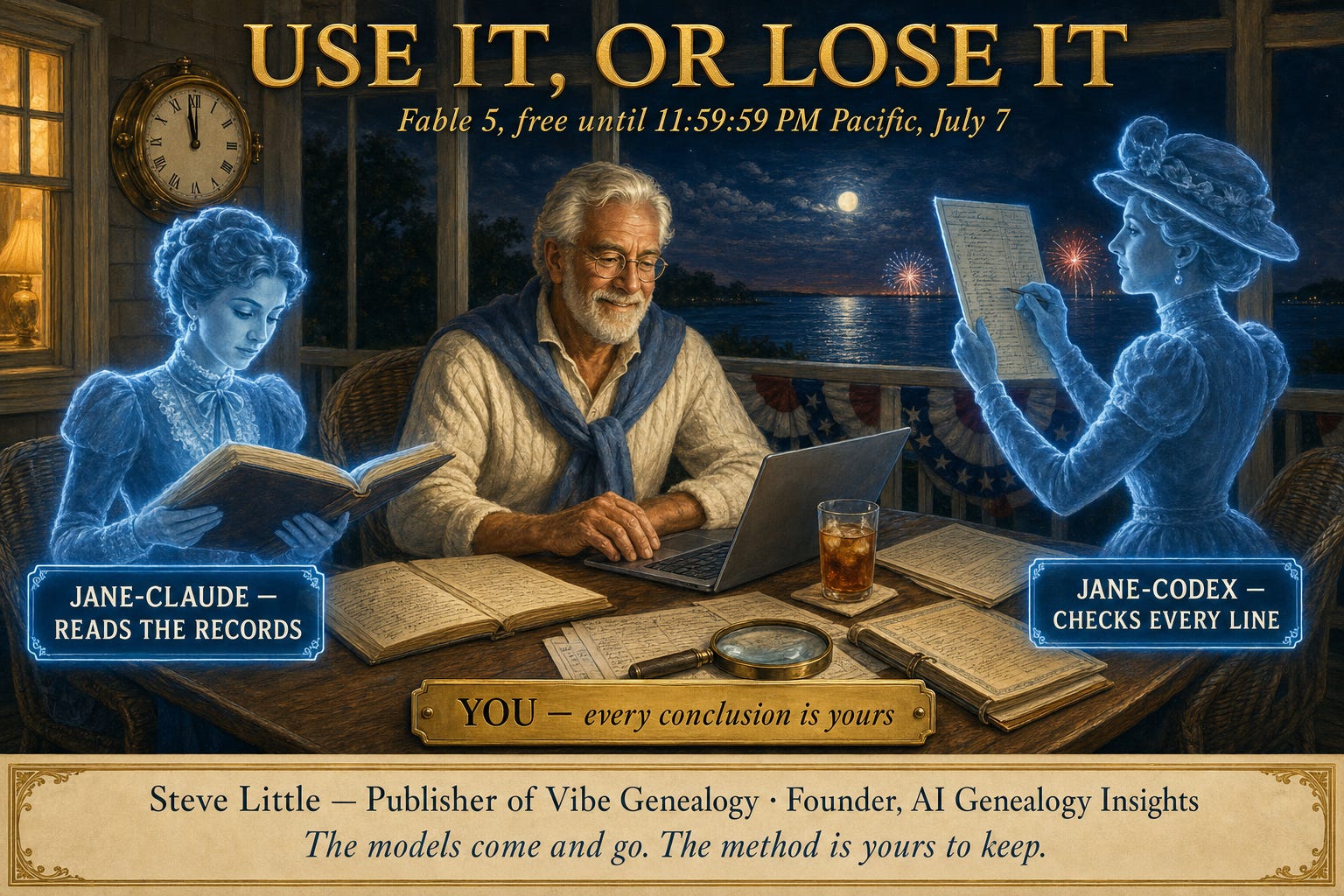
Here’s who showed up to be graded. In one window on my screen: Claude, doing the work, reading each record, figuring out who’s who, connecting the same people across different documents. In a second window: an AI from a different company (OpenAI’s Codex), with exactly one job: check Claude’s work and try to find mistakes.
The two of them never spoke. Every message between them passed through my hands, and every decision that mattered stopped at my desk. If that arrangement sounds familiar, it should. It’s what we already do when we ask a colleague to review a proof argument before we publish it. I just did it with machines, at nine o’clock on a Monday night, at a borrowed table by the Sound.
The checker earned its keep four times. Four separate times during the evening, the second AI caught a real mistake in the first one’s work: results that weren’t ready to lock down, a bug that had silently dropped rows from a table, paperwork defects I was about to sign off on, and, sneakiest of all, an error in the grading arithmetic itself after the answer key was opened. Every one got fixed and re-checked before I approved anything. One brilliant assistant would have sailed right past some of those. Two rivals, checking each other, did not.

The best hour was mine, though. Around 9:30 the work hit the questions no machine should ever decide alone: is this Elias in the marriage record the same man as the Elias in the census, or two men with one name? For about an hour, the AI brought me those calls one at a time, each with its reasoning and a recommendation, and I ruled on them like a judge with a very fast clerk. Merge. Keep separate. Merge, but flag it, we need more evidence. A decision a minute, and every single one was mine. When I finally got tired near midnight and said so, the team bundled up the routine leftovers so I could spend my last attention on what mattered.

Then we opened the sealed answer key. Here is the honest scorecard, exactly as I committed to report it before I knew the results:
Made-up facts: zero. Across all 155 records, the AI never once invented a name, date, or event. When it couldn’t read something, it said so.
Privacy: perfect on this batch. All 34 records touching potentially living people were flagged for protection. None slipped through.
Connecting records: 52 of 54 pairs correctly linked. That’s the magic genealogists actually want, recognizing that the bride in this register is the daughter in that census.
The humbling one: identification. Getting the record type, the person, and the date all exactly right happened only 47 percent of the time, far below the 90 percent bar I had set. Most misses came from the AI refusing to guess dates the cropped images genuinely don’t show, which is the behavior we want; some were honest misreads of hard handwriting, which is the behavior we watch for.

My verdict, written down before the grading and unchanged after it: promising, but unproven. It does not invent. It does not yet identify records at reference quality. Both of those things are true, and the order matters.
There is much more to this experiment than one newsletter can hold: the sealed answer key, the freeze-and-fingerprint discipline, the four catches, what 47 percent really means and doesn’t. I’ll be publishing a full report on the Cold-Read-155 project here soon, with the method laid out so you can run your own version.
So when I say use it, I am not saying trust it. I’m saying that in one evening, at a beach-house table, on vacation, I ran a supervised, double-checked, honestly-graded records project that would have taken me weeks alone, and I know exactly how good and how limited the results are, because the method made it impossible to fool myself. The method is yours to keep. The model’s free window ends tonight.
Six things to try before midnight
The AI crowd on X spent this week trading “use it before it’s gone” tips. Most were written for programmers, but the best ones translate beautifully to family history. Here are six, each with a version you can paste into Claude today.
1. Ask for more than feels polite. Ethan Mollick’s advice: most people ask AI for far too little; start with “the maximum possible thing” (@emollick). For you: hand it your hardest brick wall whole. “Here is everything I know about my third-great-grandmother, including three records that disagree on her birth year. Weigh each conflict and tell me what the evidence can and cannot support. Teach me best practices for breaking through a brick wall, then apply that here.” Ask big, then judge the answer yourself.
2. Give it the whole document, not a snippet. Weak answers usually come from missing context, not bad wording (@rohanpaul_ai). For you: the entire 40-page probate file, the full pension application, the will with all its codicils. Ask who is named, how they relate, what property moved, and what’s missing. Long, messy documents are where this model earns its title.
3. Let it tidy a whole folder. One viral demo had Fable reorganize an entire messy workspace into a clean system (@ai_for_success). For you: that folder of record images with names like scan0047.jpg. Ask for a consistent naming scheme, a list of which family each image belongs to, and a duplicate check. It sorts; you approve. (This one is the exception on the list: folder work needs Claude Code or Cowork, the technical tools.)
4. Have it audit how you research. Point the model at your own habits and find “every workflow you keep rebuilding from scratch” (@alex_prompter). For you: describe how you chase a new ancestor, then ask what steps you repeat and what you routinely skip. It’s process coaching, designed to support GPS-aware work, never to replace your judgment.
5. Make it write things you keep after tonight. The sharpest observation of the week: whatever the model writes down for you outlives your access to the model (@JeremyNguyenPhD). For you: a plain-language research checklist, a citation template, a “how I analyze a census household” guide. Tonight the model leaves; the documents stay in your files.
6. Ask it to interview you. From Thariq himself: the real skill is discovering what you don’t know you don’t know (@trq212). For you: “Before we work on this brick wall, ask me ten questions about what I already know and what I haven’t checked.” The questions, more often than the answers, point straight at the record you’ve been walking past.
One more thing, so nobody mistakes this for a fire sale: there is no need to FOMO (“fear of missing out”). If tonight passes and you never got your hour with Fable 5, you will be fine. As I wrote at the end of last week's post, more good things are coming, and quickly. Stories continue to build that OpenAI's GPT-5.6, by most accounts nearly as strong, should arrive soon; perhaps today or tomorrow, probably this week. The larger pattern hasn't changed either: the models keep getting stronger, free-tier users will very likely have Fable-class AI within three to six months, and within two years, open-source models stronger than today's Mythos and Fable should run on beefy personal computers, which means completely private, strong AI, strong by today's standards, anyway; it is hard to imagine where the frontier will be by then. Tonight's deadline is real, but it is a closing window, not a closing door. Use it if you can; don't mourn it if you can't.
How to check whether you still have it
Open claude.ai and look at the model picker, the little menu where you choose which Claude you’re talking to. If “Fable 5” is listed, you have it right now, free, until midnight Pacific. After tonight it quietly disappears from that menu unless you’ve set up usage credits.

As for me: my own weekly Fable allowance reset at nine o’clock this morning, a full tank on the model’s very last free day. I intend to spend it wildly. By the time you read this, Fable and I will be deep into the Cold-Read-155 report, the follow-up experiments, and whatever else we can wring out of the hours before midnight. I’d rather end the day at 100 percent used than one percent saved.
One confession, in the spirit of honesty this publication tries to keep: much of this post was drafted by Fable 5 itself this morning, racing the same midnight it’s warning you about, with a second AI fact-checking the claims, the same arrangement that graded my 155 records last night. That isn’t a gimmick. It’s the whole point. The models will come and go, on someone else’s schedule, at someone else’s price. The method, verify everything, cite everything, decide for yourself, is the part you keep.
Use it today. Lose it at midnight. Keep the method either way.